
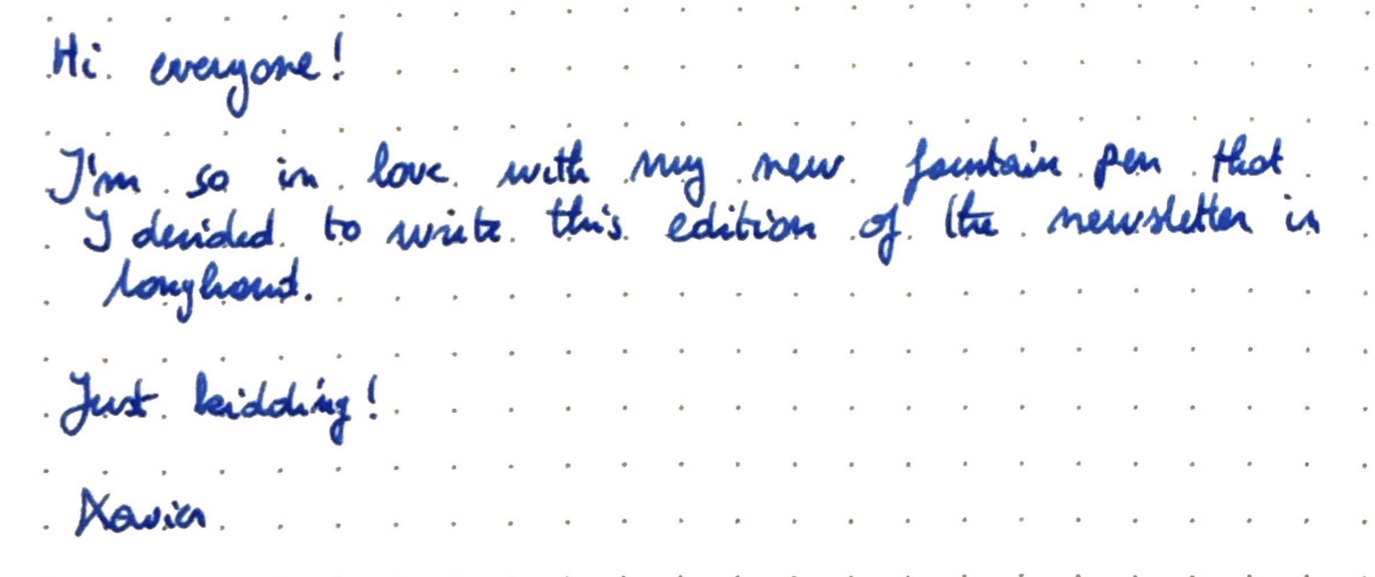
Enjoy this edition of the newsletter!
Xavier
🤓 Cool Stuff I Found on the Internet
Following strangers
Scientists tracked 100,000 people leaving a Dutch train station and found something oddly familiar: we tend to follow whoever stepped off right in front of us. Even if they're a total stranger, and even if they take a longer path. One person's choice can snowball into an "avalanche" where dozens of people behind them copy the same route.
Reprogramming matter
MIT researchers figured out how to restructure atoms of a crystal using a precisely aimed electron beam. In about 40 minutes, they created over 40,000 tiny atomic defects in a semiconductor. This technology could help us build extremely sensitive sensors, denser computer storage systems, and more.
Tool using bees
Scientists discovered bumblebees can use tools to solve problems. Researchers created a bee version of the classic “box-and-banana” test. To get a sugar reward, a bee had to roll a ball to a specific spot and climb on it. This finding suggests that even tiny brains can generate flexible solutions to novel problems. It pushes back against the idea that insects are just simple machines.
Retro-tech parenting
This parent is not banning his kids from using screens, but is instead bringing back CDs, a kitchen landline, and a family computer with a strict whitelist. The argument? Old tech gives kids real independence while parents keep tight control over what actually enters the house. It's very similar to my NFC movie library!
Hollywood's Secret Reader
Clarke Speicher’s job is to read one novel every two days and write a report on whether they’d work as films. His reports tell directors which elements are cinematic and whether they should “pass” or “consider” the project.
⏳ On this day...
1895 - Émile Levassor won the first automobile race, driving from Paris to Bordeaux and back in just under 49 hours.
1983 - Pioneer 10 became the first human-made object to leave the central Solar System when it passed beyond Neptune.
1966 — The U.S. Supreme Court ruled police must inform criminal suspects of their rights before questioning them. It’s the origin of “You have the right to remain silent”.
🧠🤖 Artificial intelligence
Anthropic calls for freeze in AI development
Anthropic called for a coordinated global pause on frontier AI development, warning that models may soon be able to design and train their own successors with minimal human oversight. Seems very noble of them, or is this their way of preventing their competitors from catching up?
DeepMind CEO: prepare for AGI
Demis Hassabis says general artificial intelligence could land around 2030, and he thinks that will kick off a whole new chapter for humanity. He sees medical breakthroughs and a post-scarcity world, but he also says society doesn't have much runway to figure out what that actually means.
👽 Space
The leaky ISS
There's been air leaking from the ISS since 2019 and it slowly got worse. Recently, 5 crew members had to shelter in a SpaceX Dragon capsule for 90 minutes while Russian cosmonauts repaired a leaky transfer tunnel. I guess nobody brought duct tape?
AI in space, a bad idea?
Everyone’s racing to put AI chips in orbit because space offers unlimited solar power and “free” cooling. However, the vacuum of space is the worse possible heat sink. So why are many companies pursuing it anyway?
Why not Venus?
Maciej Cegłowski argues we shouldn’t be fixated on Mars and instead look toward Venus. It’s closer to Earth, has an atmosphere that can shield us from radiation, and there might be life in the clouds. The only downside is: we’d have to live in floating air balloons because the pressure on ground level would instantly crush us.
🏥 Health & Medicine
AI-designed vaccine
Researchers at Cambridge used AI to design a "super-antigen" vaccine meant to protect against whole families of coronaviruses. This antigen targets shared weaknesses across many related viruses and could allow us to create vaccines proactively rather than reactively.
Google wants to "debug" California
Google is asking the EPA to release up to 32 million sterilized male mosquitoes in California and Florida over two years. The idea behind its Debug program is simple: flood neighborhoods with sterile males to reduce the total population. This method has already been used in Singapore where it led to an 80-90% reduction in the mosquito population and a 70% drop in dengue cases.
Ancient yeast
Scientists studying Ötzi the Iceman found cold-loving yeast still living in his gut, skin, and meltwater. So what do you do with those? Spend three months creating sourdough bread with it, of course!
Fully simulated fruit fly
Scientists at Eon Systems took a full wiring map of a fruit fly brain and built a digital version of it. They then connected this digital brain to a virtual environment and discovered that their digital actually fly came alive! This is getting close to scanning a brain and uploading it into a computer.
⚡️ Energy & Environment
A million vapes a day
The UK banned single-use vapes a year ago, but around 6.3 million devices still hit the bin every week. And that’s a problem, because vapes caused over 80% of fires at UK recycling sites last year.
Inside a BYD
Lumafield ran four BYD parts through an industrial CT scanner: a battery cell, a door switch panel, a portable charger, and a key fob. The scans can catch the smallest imperfections, like slightly uneven battery windings.
Super El Niño is coming
Forecasters think we’re heading into a strong El Niño this year. It means large parts of the Pacific get unusually warm and start affecting weather patterns around the world. Some places will face extreme droughts, while others will face floods.